Bug Out Bag Essentials Checklist

A bug out bag checklist is the list of what to pack so you can leave home in a hurry and be covered for a 3-day evacuation. In short, that means water and a way to treat more, food, shelter and warm clothes, and light and power. Add first aid and your prescription medicine, a few tools, copies of important documents and some cash, plus personal items for each person and pet in your household. The full checklist is below, grouped so you can tick items off as you pack.
What Is A Bug Out Bag?
A bug out bag (or B.O.B.) is a bag you pack ahead of time so you can grab it and go if you ever have to leave your home in an emergency. It is not your whole emergency supply. It is the part you can carry.
On This Page
That difference matters. The American Red Cross lists water and food as a 3-day supply for evacuation and a 2-week supply for home, and it suggests keeping supplies in an easy-to-carry emergency preparedness kit you can use at home or take with you if you must evacuate. A bug out bag is the evacuation side of that. If you are still deciding whether you would stay or go, read about the difference between bugging in and bugging out first, and see how the bag fits into household emergency preparedness as a whole.
Why A Bug Out Bag Is Hard To Put Together
Every item in a bug out bag is a trade-off between how important it is, how much it weighs, how sturdy it is and how much it costs.
A bug out bag is hard to put together. The reason for that is because it is hard to keep a balance between these 4 things:
- Prioritize the more important items
- Keep the bug out bag light enough that you can carry it comfortably for couple of hours or more
- Make sure that your bug out bag’s contents are sturdy enough for an emergency that might involve running, getting them wet, dropping them, etc
- Make sure that you can afford the bug out bag items
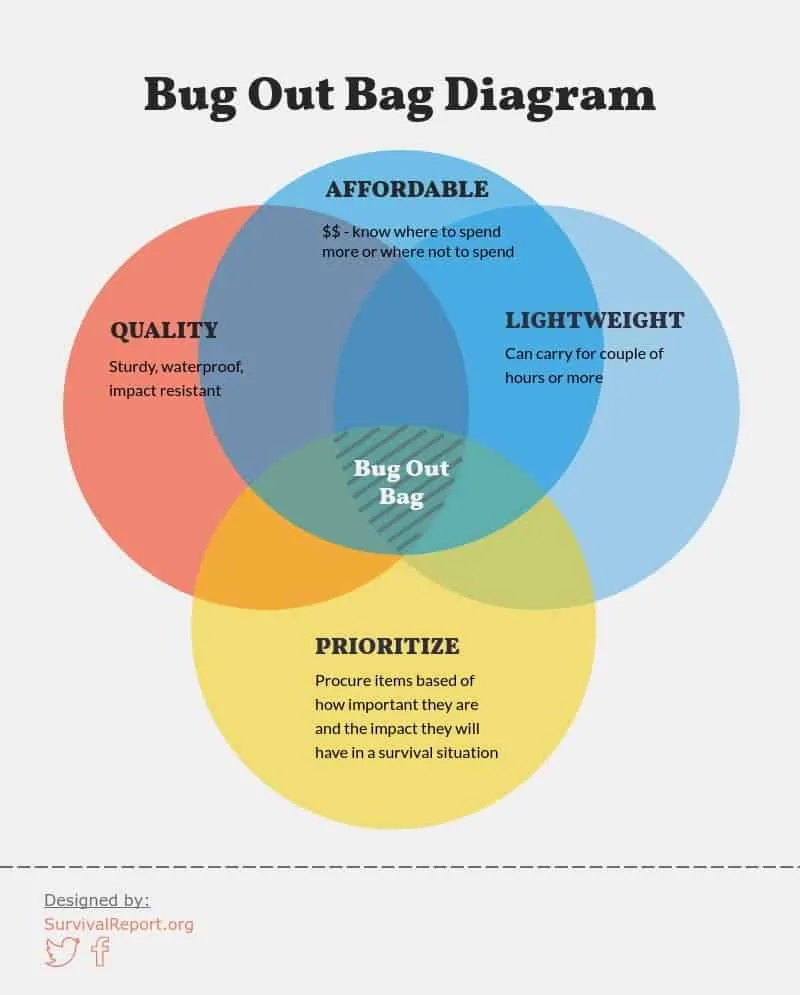
The diagram above shows you the most important bug out bag features and how they interact with each other. A lot of survival guides recommend B.O.B. items that are:
Low-Quality B.O.B Items
- Example: radio with solar panel flashlight & smartphone charger. While it sounds good in theory, the solar panels take literally days to charge a small percentage of a smartphone battery. Also, the device has not been extensively tested for field use and might stop working when you need it most.
High Priced B.O.B. Items
- Example: A nice lightweight backpack that you can purchase for $600. It might even be worth spending the money if you plan to use it regularly for camping, hiking or making a fashion statement. If not, you can buy a very similar one for $250-$300
Heavy B.O.B. Items
- On their quest to get commissions for your purchases (everyone’s gotta make a living somehow), they forget to tell you that you won’t be able to drag your 120 lbs backpack for very long
Useless B.O.B. Items
- Some items they feature are only meant for situations that are very unlikely (read almost impossible) to happen. Actually, you either cannot purchase some of the most important items for your bug out bag (besides the backpack itself) – emergency plan with escape routes, document copies, cash or you already have those items (prescription medicine, jewelry, electronics, other valuables).
If you are stuck choosing between two versions of the same item, our bug out bag gear guide compares equipment options in more detail.
72 Hours Bug Out Bag Checklist
Pack your bug out bag in these groups: the pack and your plan, water and food, medicine and medical supplies, fire and tools, shelter and clothing, light and communication, hygiene, and your pets and valuables.
The following are the most essential B.O.B. items. You should probably add your own items that are fit for the area in which you live, family items, etc.
Bag, Plan And Documents
- Backpack – lightweight, waterproof has hip belt
- Bug out plan (including maps, escape routes, meeting places, etc), copies of important documents & money
Water And Food
- Drinking water. The American Red Cross lists one gallon per person, per day, with a 3-day supply for evacuation. That gets heavy fast, so also plan how you will treat more water, which is why the filter and tablets below are on the list
- Water filter & water purification tablets
- Emergency food & lightweight cooking gear
- Instant coffee
For how to treat water in an emergency, follow the EPA’s emergency disinfection guidance and the instructions that come with your filter or tablets.
Medicine And First Aid
- Prescription medicine
- Pain reliever & fever reducer
- Acid reducer & allergy medicine (as needed)
- Dust and pollen mask
- First aid kit (add items that are missing)
- Add these to the first aid kit (if it doesn’t have them already) – antibiotic cream, children pain reliever/fever reducer, sunscreen, small hand sanitizer, insect repellent, bandages
The Red Cross basic supplies list includes medications (a 7-day supply) and medical items. Ask your doctor or pharmacist how to keep extra prescription medicine on hand, and how to store it.
Fire, Tools And Repairs
- All weather fire starter
- Multi-tool
- Survival knife
- Paracord
- Survival hatchet
- Duct tape
Shelter, Sleep And Clothing
- Lightweight tent
- Lightweight sleeping bag
- Waterproof gloves
- Clothes & rain poncho
Light, Power And Communication
- Power bank
- Tactical flashlight
- Radio
- Compass
- Binoculars
- Electronics (smartphones, tablets, etc) – put in large Ziploc bag, wrap with clothes to protect from shock
Hygiene
- Toilet paper
- Feminine hygiene products
Pets And Valuables
- Pet food (72 hours)
- Jewelry & other valuables (hide well)
Want a printable bug out bag checklist? Print this page and mark each item Have, Need or Checked, or copy the list into a note on your phone.
Personalize Your Bug Out Bag
Personalize a bug out bag by splitting the list into shared items carried for everyone and personal items each person carries, then adjusting for kids, older relatives, pets, your area and the season.
No two bags should be identical, because no two households are. Start by splitting the list into two kinds of items.
- Shared items that one bag can carry for everyone, such as the tent, cooking gear, hatchet, radio, binoculars and duct tape. Spread them between the adults so no one bag gets too heavy.
- Personal items that every person needs in their own bag, such as clothes, a sleeping bag, water, food, their own prescription medicine and copies of their documents.
A Bug Out Bag Checklist For A Family
- Kids: a small bag they can actually carry, a change of clothes, a snack they like, a comfort item and a card with your family’s phone numbers and meeting places.
- Older relatives or anyone with limited mobility: pack around what they can carry, and keep their medicine and any aids they rely on in the bag that travels with them.
- Babies: diapers, wipes and whatever they eat, packed for the same 72 hours as everyone else.
- Pets: besides the pet food, a leash or carrier and copies of their vet records.
Your Area And The Season
A bag packed for a Minnesota winter is not the bag you want for a Florida summer. Swap clothes, gloves and sleeping gear with the seasons, and add maps of the places you would actually drive or walk to.
Check Your Bag Before You Need It
Check your bug out bag on a schedule: replace expired food and medicine, charge and test the electronics, swap clothes for the season and refresh stored water.
A bag you packed three years ago and never opened may not work when you need it.
- Check expiration dates on food and medicine, and replace anything that has expired.
- Charge the power bank and test the flashlight and radio.
- Swap clothes and sleeping gear for the coming season.
- Replace stored water that was not commercially bottled every six months, as Ready.gov advises.
- Update document copies, phone numbers and meeting places when anything changes.
- Put the packed bag on and walk with it. If you cannot carry it comfortably for a couple of hours, take something out.
When your household practices its emergency plan, make grabbing the bags part of the drill. It is the fastest way to find out which bag is too heavy and whose is missing a flashlight.
Bug Out Bag Vs Other Emergency Kits
A bug out bag is the portable kit for leaving home, which makes it different from your larger home emergency supplies and from a smaller get home bag.
- Home emergency supplies: the bigger stock you would use if you stay home. The Red Cross lists a 2-week supply of water and food for home.
- Get home bag: a smaller bag you keep at work or in the car, with just enough to get you back home if something happens while you are out.
- Bug out bag: the 72-hour bag on this page, for leaving home.
If you want to understand why these equipment categories matter in the first place, start with the essentials and then come back to this list.
What would you add to this list? Share the items in your own bug out bag in the comments section.


